http://www.cbc.ca/radio2/cms/images/20080122charl/CharlesForemanChopinProg.pdf

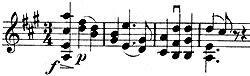
123456The Op. 62, No. 1 Nocturne is the longest work Chopin ever wrote under this title,
lasting nearly nine luscious minutes. Especially in England and the southern US, it is
sometimes called the “Tuberose:” it is at moments like this that I, for one, am grateful for
nicknames that don’t stick. The delicate, autumnal qualities of this remarkable essay in

tesol 發表在 痞客邦 留言(0) 人氣()


http://programnotes.wikia.com/wiki/Sonata_No._9_(op._47),_%22Kreutzer%22

According to the original title page, this sonata for violin and piano is "in a style molto concertante almost like that of a concerto". It was both completed and premiered in 1803 while Beethoven was in Vienna. Though the composer had completed the finale approximately three years earlier, the first and second movements were ready only moments before the first performance of this work, and the featured violinist was forced to play them at sight. Additionally, the piano part remained practically blank at the premiere, but with the composer himself performing, one did not need written notes. For a brief time, the sonata was known as the Bridgetower Sonata, dedicated to the violinist who premiered the work. However, a quarrel between Beethoven and Bridgetower encouraged the composer to re-dedicate the work to Rudolphe Kreutzer instead, a Parisian virtuoso violinist whom Beethoven had heard perform in Vienna. Ironically, Kreutzer himself never performed the work, especially after a broken arm later compelled Kreutzer to give up violin playing.

http://www.classicalnotes.net/classics2/kreutzer.html

In contrast to all eight of his previous violin sonatas that began with the piano抯 plain statement of the melody, key and tempo, here the soloist wanders out naked and lost. The tempo indication, adagio sostenuto, barely stirs and the score presents an immediate challenge – how the violinist, able to sound only two strings at once, is to sustain the static opening figures of three- and four-note chords without disrupting their tense continuity. Upon the piano抯 sudden entrance, the key shifts abruptly from A major to a minor, from which it never recovers. Conventional wisdom is that Beethoven, a concert pianist, wrote a dominant role for his own instrument, but that抯 not really true – he was also an accomplished violinist and in any event had to provide display opportunities for guest artists at his concerts. Indeed, the key to writing duo-sonatas is to find themes that exploit the distinctive expressive character of both instruments, while suggesting a wide range of possibilities for accompaniment. Here, the relationship between violin and piano is complex – they both blend and chafe, suggesting a common purpose, yet plunging into frenzied competition as the piece erupts into an astoundingly stormy movement, which Beethoven aptly described on his score as 搎uasi come d抲n concerto?/i> (揳lmost like a concerto? that heaves between gentle respite and exhausting, violent attacks of furious slashing figures at a delirious pace (labeled 損resto?/i> and generally taken anywhere between 300 to 500 beats per minute).

Tolstoy pronounced the second movement 揷ommon and unoriginal?and the finale 搗ery weak.? That抯 a bit harsh, yet sensible – nothing really could top the scope and fervency of the first. Beethoven meets the challenge brilliantly but subtly, while again disrupting our expectations for a worthy successor to the opening frenzy, this time with a genial andante, a throwback that would fit in any of his prior works, comprising a placid theme with four variations of escalating complexity – first with piano figuration, then the violin elaborates, next a plunge into f-minor, and finally ornate combinations. It抯 as if, having depicted his rebellious angst, Beethoven assures us that his inner soul remains loving and steeped in common values and that he knows how to fulfil social expectations.

tesol 發表在 痞客邦 留言(0) 人氣()

http://www.calperfs.berkeley.edu/presents/season/2003/program_notes/pdf_files/pn_ax.pdf

Claude Debussy Images for Piano, Book I
Reflets dans l’eau
Hommage à Rameau
Mouvement

tesol 發表在 痞客邦 留言(0) 人氣()

http://www.daytonphilharmonic.com/content.jsp?articleId=1332

String Quartet, op. 18, No. 1
Instrumentation: 2 violins, viola, cello
This is the first time the DPO has performed this piece.
Although Beethoven dedicated the whole 0p. 18 set of string quartets to Prince Lobkowitz, a loyal and enthusiastic patron of Beethoven's, an earlier version of the Op. 18, No. 1 quartet existed, and Beethoven dedicated it to his friend, Karl Amenda. Amenda was a theologian and violinist, who made Beethoven's acquaintance in Vienna. Apparently, Beethoven was unhappy with his first version of the quartet and wrote Amenda a letter requesting that he not show to, or allow anyone to played it. Beethoven added that he had a lot to learn about quartet writing and had finished a new version of the piece.

tesol 發表在 痞客邦 留言(0) 人氣()

http://en.wikipedia.org/wiki/Cello_Suites_(Bach)#Suite_No._3_in_C_major.2C_BWV_1009

Suite No. 3 in C major, BWV 1009

The Prelude of this suite consists of an A-B-A-C form, with A being a scale-based movement that eventually dissolves into an energetic arpeggio part; and B, where the cellist is introduced to thumb position, which is needed to reach the demanding chords. It then returns to the scale theme, and ends with a powerful and surprising chord movement.

The Allemande is the only movement in the suites that has an up-beat consisting of three sixteenth-notes instead of just one, which is the standard form.

The second Bourrée, though in C minor, has a 2-flat (or G minor) key-signature. This notation, common in pre-Classical music, is sometimes known as a partial key-signature.

tesol 發表在 痞客邦 留言(0) 人氣()

http://www.calperfs.berkeley.edu/presents/information_desk/program_notes/2007/pn_richard_goode.pdf

Gabriel Fauré (–)
Nocturne No.  in D-fl at major, Op. 
Composed in .
Gabriel Fauré was an accomplished pianist, though

tesol 發表在 痞客邦 留言(0) 人氣()


http://en.wikipedia.org/wiki/Piano_Concerto_for_the_Left_Hand_(Ravel)

[edit] Structure

Ravel is quoted in one source as saying that piece is in only one movement (Daily Telegraph 11 July 1931 p. 364) and in another as saying the piece is divided into two movements linked together (Le Journal 14 January 1933, p. 328). According to Marie-Noelle Masson, the piece has a tripartite structure: Slow-Fast-Slow, instead of the usual Fast-Slow-Fast. Whatever the internal structure may be, the 18-19 minute piece negotiates several sections in various tempi and keys without pause. Towards the end of the piece, some of the music of the early slow sections is overlayed with the faster music, such that two tempi occur simultaneously.

Excerpt from Piano Concerto in which two themes are presented simultaneously in different time signatures.

tesol 發表在 痞客邦 留言(0) 人氣()

http://www.sccs.swarthmore.edu/users/03/hhsu1/music_articles/schubert_arpeggione.html

"Who nowadays would remember this strange instrument called the 'guitar-violoncello' had not Franz Schubert written a glamorous and virtuousic sonata for the 'Arpeggione', as he called the instrument?", writes editor Wolf-Dieter Seiffert in the preface of a particular print of this sonata. He raises a valid point: invented in 1823 in Vienna by Johann Georg Staufer, the six-string instrument - fretted and tuned like a guitar, held and bowed like a cello - never quite caught on and quickly went out of fashion - and for a good reason, too, by an account of a former teacher of mine, with whom I recently chatted about this piece. Another music critic even goes so far as to say that the sonata "makes far greater effect when performed on the cello, viola, flute, clarinet or, indeed, virtually any other instrument than the one for which it was conceived."

The "Arpeggione" Sonata's flair and fun for performers and audience alike certainly have played a major role in helping the work survive to the present day despite the original instrument's rapid demise. While the work now also exists in versions for the viola and the violin, the cello version appears to be the most favored one, although the smaller number of strings and lower tuning of the instrument compared to the Arpeggione make a successful performance of the sonata a significant technical challenge.

tesol 發表在 痞客邦 留言(0) 人氣()

http://homepage.mac.com/deyestone/brahms.html

As appears typical of brahms, I found the principle motive to be stated in the first and second bars; b-c-b. This half step plays an extremely important role in hearing the variations liquidate over the course of the first movement. Throughout the movement there are what I am calling interlocking motives. A clear example of this is in measure 3;

a-b-a

a-g-a

tesol 發表在 痞客邦 留言(0) 人氣()

Capriccio for piano in G minor, Op. 116/3

http://shopping.yahoo.com/p:Capriccio%20for%20piano%20in%20G%20minor,%20Op.%20116%2F3:1920135211

The Fantasies (7) in Brahms' Op. 116 set consist of four intermezzos and three capriccios (Nos. 1, 3, and 7), the former group rather serene if sometimes dark in character and the latter trio are stormy, troubled compositions that suggest an anxious, even angry frame of mind. That said, this Capriccio in G minor, for all the agitation and nervosity in its outer sections, features one of his most glorious and serene episodes as its central panel, serving as a kind of oasis in an unsettling emotional desert. This capriccio opens with an agitated downward swoop that struggles upward, forming a U-shaped contour that is then answered in kind in the middle register. Anxious Chopin-esque swirls of notes -- sometimes rising, sometimes descending -- alternate with it. The middle section features one of Brahms' most grandiose and confident creations, with a theme (Un poco meno allegro) that reaches into ecstatic realms of expression. The main material returns (Allegro passionato) to close out the piece, bringing along the same vehemence and agitation from its first appearance. This masterful capriccio typically has a duration of three minutes. ~ All Music Guide

tesol 發表在 痞客邦 留言(0) 人氣()

http://www.answers.com/topic/sonata-for-solo-cello-op-8
The sonata begins with a very serious-minded Allegro maestoso ma appassionato, featuring big gestures and alternating between anger and acquiescence. The second movement, Adagio con grand' espressione, begins with a dark, meandering melodic line accompanied by occasional resonant pizzicati. After a much more aggressive central section, the music slows again and works its way to a spare and haunting conclusion. With the third movement, Allegro molto vivace, the listener is plunged into the world of Hungarian folk music. This headlong, vigorous, and diverse movement is full of virtuoso passages featuring pizzicati, double stops, and fast repeated notes and runs, and makes for an exciting conclusion.

http://www.naxos.com/mainsite/blurbs_reviews.asp?item_code=8.553160&catNum=553160&filetype=About+this+Recording&language=English

Dedicated to Kerpely and first played by him in Budapest on 7th May 1918, the Op. 8 Sonata (1915), admired by Bartók for its "unusual and original style ...[and] suprising vocal effects", is an extraordinary tour de force, not so much a reply to unaccompanied Bach as a visionary credo in pursuit of the ultimate, regardless of medium or technical limitation. In seeking his (B minor/major) goal, Kodály even has the lower two strings tuned down a semitone from normal (giving the configuration B-F sharp-D-A), notating them further as a transposing part. Inwardly, the three movements are tightly linked by recurring motifs and intervals. Outwardly, however, the impression is more random, a pageant of rhapsody and change, of sudden contrasts and pensive reflections, all exquisitely detailed in rhythm, phrasing, inflection and dynamics. Epic counterpoint and arresting gesture, recitatives, songs and dances, drones, shepherd pipes, zithers and cimbalons, veritably a whole gypsy orchestra, make up Kodály's vibrant dreamland. As monumental for cellists as the Liszt Sonata is for pianists, no more challenging a work exists. Kodály was never again to tackle the form.

tesol 發表在 痞客邦 留言(0) 人氣()

http://en.wikipedia.org/wiki/Piano_Concerto_No._2_(Prokofiev

tesol 發表在 痞客邦 留言(0) 人氣()

1 2
Blog Stats
⚠️

成人內容提醒

本部落格內容僅限年滿十八歲者瀏覽。
若您未滿十八歲,請立即離開。

已滿十八歲者,亦請勿將內容提供給未成年人士。